Being Mortal
July 06, 2025• #cancerWhen I got the message that Appa did not have much time to live, I flew down to India immediately. I had two weeks with him during which I read obsessively. If I had not blocked YouTube and Twitter, that's where my mind would have been. It was as if I did not want to be alone with my thoughts.
The last book I read in his presence was Atul Gawande's Being Mortal, which I finished as my father slipped away in the hospital bed beside me. The timing was cruel and illuminating. Here was a surgeon writing about everything his doctors had failed to do: have honest conversations about prognosis, discuss quality of life, acknowledge when cure was no longer possible.
Gawande observes how abnormal contemporary death has become. In the United States, as recently as 1945, most people died at home. By the 1980s, only 17 percent did. We have medicalized dying in ways unprecedented in human history. For most of our species' existence, people died young from disease, injury, war, long before old age, and mostly surrounded by family or friends in familiar spaces. The idea of dying in a sterile hospital, attached to machines, monitored by strangers, would have been incomprehensible even a hundred years ago. This new normal has been created unthinkingly, one decision at a time, without anyone questioning whom exactly it is serving.
The Machinery of False Hope
After R-CHOP chemotherapy (a combination drug treatment) and CAR-T cell therapy, my father's lymphoma persisted. Nothing I could find online suggested the cancer would regress with further treatment. Yet his new oncologist, let's call him Dr. V, proposed another round of chemotherapy followed by Venetoclax. When I searched for literature on this combination for relapsed lymphoma, I found virtually nothing promising.
The moment I realized we were trapped in medicine's false hope industrial complex came during a meeting with this new oncologist. I wrote in my journal afterward, in frustration: "His interpretations of events were different from mine or appa. Either lying or foolish, unwilling to listen. Gaslighting." He seemed strangely uninvested in the outcome, curious in an academic sense about whether the treatment might work, but disconnected from my father as a person facing death. More telling, his narrative about my father's disease progression contradicted our lived experience. He insisted the back pain that had tormented my father began with radiation; we knew it started the moment he began chemotherapy months earlier.
Dr. V, like some in Gawande's book, focused only on "the next thing to do," which was either immediate medication, another surgery, or one more round of treatment. Never: What does a good death look like? What matters most to you in your remaining time? How much suffering are you willing to endure for what probability of benefit? Is there a going back to previous mode of living if a treatment plan works?
My father's previous oncologists had been straightforward. They suggested palliative care when cure was no longer realistic. But Appa despised that word and would go apoplectic at its mention. If I had read Gawande earlier, I might have had better language to help him understand that choosing comfort over futile treatment wasn't surrender.
In April, I spoke to Dr. V and his team alone. I opened with a pointed question: "Have you seen any patients with gastric fistula (an abnormal opening in the stomach wall) recover when surgery is not an option?" They demurred. I had to push them to state what should have been obvious: how much time did my father have? A few weeks to a couple of months.
Within days of my return to California in May, I was shocked to learn they wanted to proceed with Venetoclax and more chemotherapy anyway. The treatments sent my father spiraling into worse agony. In June, a CT scan revealed the cancer had spread to his intestines and pancreas. I had my mother connect me to the trainee doctor who told me my father had only a few days to live, while mentioning nothing to my mother who was next to him. That same day - June 16 - they administered polatuzumab with rituximab, a targeted therapy costing 250,000 rupees (over $3,000) for a single 30mg dose. This was not palliative care - it was another attempt at tumor reduction for a man with days to live, with known side-effects.
Why did the doctors allow themselves to be browbeaten by a patient unwilling to accept mortality, continuing treatments they knew were futile? Their incentives made it impossible to step back. Here was a patient with good insurance, willing to try anything. Another data point for the literature, given the interest of the group in publishing.
That last night I spent with my father, his breathing gradually became labored. He had little or no consciousness left, just the mechanical rhythm of lungs and heart. When the doctors suggested a ventilator, I said no. It would have kept his body functioning a few more days in the ICU, but we wouldn't have been there when the end finally came. That choice to let him go felt like the first honest medical decision in months.
Seeing someone die, even when you expect it, feels like a punch to the chest. The machine starts beeping. His breath stops. Yours catches. The unnecessary suffering, both his and my mother's, that preceded it made me very angry. My father could have spent his final months traveling to Madurai, or we could have made that trip to Swamimalai in January with his granddaughter. Instead, we have this.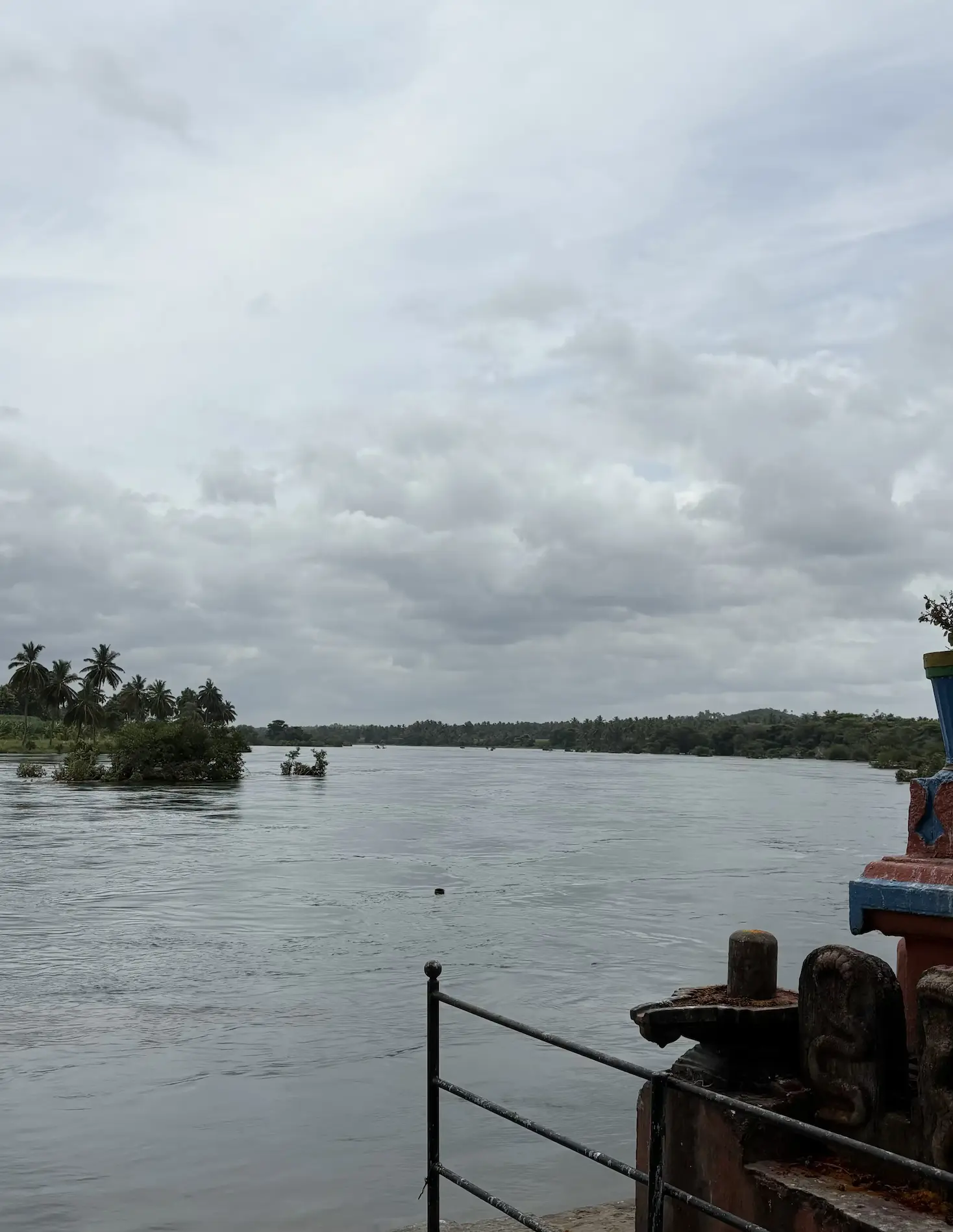
After his death, I performed the first two days of his Shraddham in India. Shraddham is the Hindu ceremony where one offers food and prayers to deceased ancestors. This would be his final samskara, his last ritual, and he would have wanted it done correctly. But the Shraddham is also my rite of passage. For thirteen days after a parent's death, the eldest child must perform these daily rituals. On the 12th day, he becomes a pitr, an ancestral spirit.
Offering ghee to the fire with atti leaves (from the same berry-laden branches found on IVC seals from four thousand years ago), chanting Vedic hymns, and invoking the Puranic gods, I was part of an unbroken chain, first-born sons performing these same acts across generations. Once I would have found it macabre picking up skeletal remains of my cremated father. Over the two days, any misapprehensions I might have had about things said or left unsaid to my father disappeared. It was a privilege for him to be sent this way, and it was a privilege for me to send him in this manner.
I took his ashes to Srirangapatnam, where the Kaveri River was in full monsoon spate, and watched them dissolve into waters that have carried such offerings for millennia. Back in California, I continue the daily ritual: rice, ghee, and sesame seeds offered to quench his spirit. In India, these would go to crows who carry offerings to ancestors. The Bay Area has no such crows that understand their ritually sanctioned role, so the pindam finds its way to the creek near my home, into the stomachs of ducks, geese, and fish.
He now traverses two rivers, in two countries, thirteen thousand miles apart.
What Remains
Modern medicine offered my father only procedures that prolonged his suffering without extending meaningful life. When cure is possible, medicine is miraculous. When cure is impossible, it becomes torture. For making peace with end of life, ritual tradition hints at one framework for accepting death with dignity, a way to transform loss into connection across generations. Death was once widely accepted and everyone had to prepare for it in advance - it's a samskara after all. Gawande's research confirms what this preparation accomplished. In the context of hospice care, he notes:
"Two-thirds of the terminal cancer patients in the Coping with Cancer study reported having had no discussion with their doctors about their goals for end-of-life care, despite being, on average, just four months from death. But the third who did have discussions were far less likely to undergo cardiopulmonary resuscitation or be put on a ventilator or end up in an intensive care unit...In other words, people who had substantive discussions with their doctor about their end-of-life preferences were far more likely to die at peace and in control of their situation and to spare their family anguish."
The medical system fails to recognize that patients have priorities beyond merely staying alive. This stems partly from our collective inability to accept human limits and largely from hospital incentives that are at odds with patient needs.
Had his doctors read their own literature more honestly, had they practiced the difficult conversations Gawande advocates, my father might have chosen differently. He might have refused Venetoclax, skipped the final round of chemotherapy, focused on comfort rather than cure. He might have died at home instead of in a hospital, surrounded by family rather than monitors.
The rituals continue. They provide a structure for mourning, daily acts that gradually transform the relationship from a living parent to ancestral presence. The mourning period is one year, with the 27th day and 45th day observed by specific rituals, part of a series of monthly observances. Orthodox Hindu traditions, while seemingly frozen in time, are eminently negotiable. Perhaps this is how conservative religious institutions survive, by adapting. The Catholic Church no longer penalizes usury or insists on Latin mass, yet remains unmistakably Catholic. My father's being now connects the Indian river of his boyhood and the California creek he explored as a new grandparent. For thousands of years, these rites for his ancestors were contained within Bharatavarsha, the geography named in sankalpa, statement of intent that precedes Hindu rituals. Now it is Ramanakavarshe. The ceremony endures.